They keep their writing
When the class ends it stays open to them — their work, the teacher’s replies, the whole room, still there to read. Nobody else in the category does that.

Everyone in a small class does this week’s work in the same window and reads each other’s hand-ins. That’s where “we’re in this together” actually comes from — and no feed produces it.
Nothing to migrate. Your checkout stays where it is. Already in a class? I have an invite
Your highest-ticket group — the mastermind, the certification cohort. Do those people talk on the platform you pay for, or in a chat thread?
Right. That’s everyone. The platforms are feeds, built to hold an audience, and the moment the work gets personal everyone leaves for a chat app. The teaching never happens on the platform.
LearnParty is built as the room instead.
When the class ends it stays open to them — their work, the teacher’s replies, the whole room, still there to read. Nobody else in the category does that.
A class of eight to twenty does the same assignment in the same week and reads each other’s work. Nothing to scroll. Nobody is the audience.
Who is waiting on your word, who has gone quiet, and every reply in one place. Everywhere else, you go looking.
Every classmate is on the same chapter. When something happens in the room an email says so — every message, not a weekly round-up. The class comes to them; they never have to remember to check.
Hand-ins are read by the whole class, and the teacher leaves a comment on each one. A gold star is a sticker the teacher put there, and it always says why.
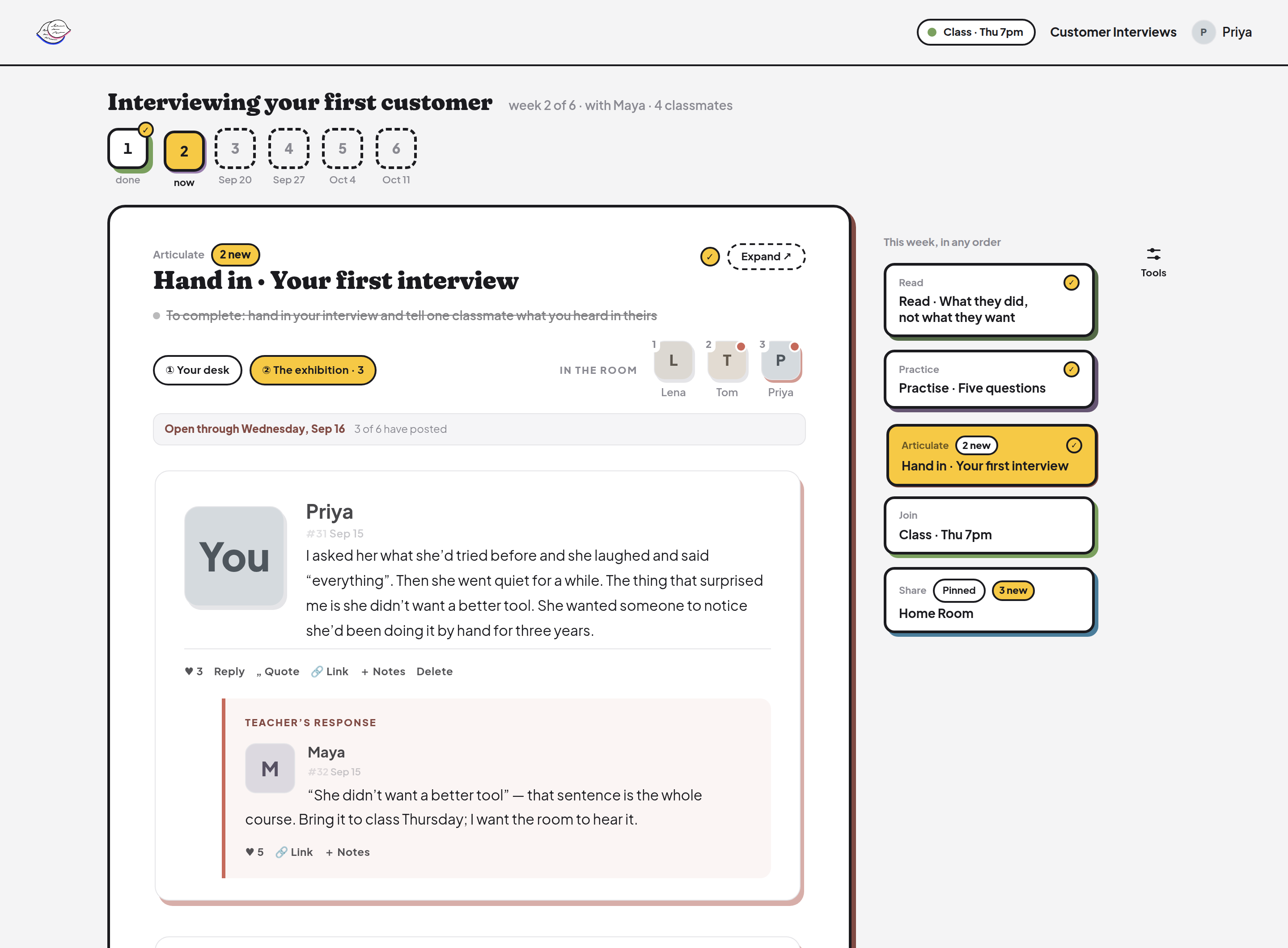
Priya’s hand-in Week 2 · Interviewing your first customer
I asked her what she’d tried before and she laughed and said “everything”. Then she went quiet for a while. The thing that surprised me is she didn’t want a better tool. She wanted someone to notice she’d been doing it by hand for three years.
Maya (teacher): “She didn’t want a better tool” — that sentence is the whole course. Bring it to class Thursday; I want the room to hear it.
Week two of a customer-interview class: one prompt, a window that closes on Wednesday, three hand-ins so far — and the teacher’s answer to each one sitting underneath it, where the whole class reads it.
We’ll set the course up together — your material, your rhythm, your voice.
Your students get a small room where everyone does the work in the same week and reads each other’s hand-ins. You get a desk that shows you who needs you. Everyone gets an email when something happens.
Your checkout stays wherever it is today. Nobody migrates anything. And when the class ends it stays open to your students — nobody loses what they wrote.